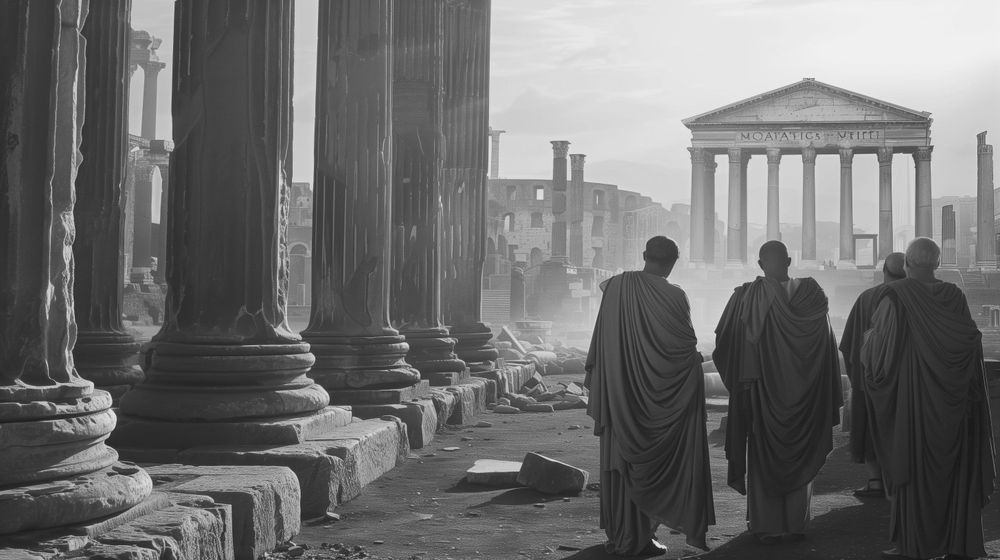
In its very infancy, the New Testament church burst upon the scene, shaking the very foundations of both the pagan and Judaic worlds. She came aflame with love to God and man and turned the world upside down. Hungry, penetent souls shouted for joy at her coming, while those who loved darkness gnashed their teeth and cursed her onward march.
Undaunted by persecution and hardship, the early saints embraced the cross, bore the reproach, and rejoiced in the God of their salvation. Their hearts were fixed on “a better country, that is, an heavenly,” knowing “they were strangers and pilgrims on the earth.”
According to Robert Louis Wilken, professor of history and author of many books on the early church, the first Christians did not conform to the culture of the day. They declared that God–not culture–defined who they were. The church was itself a culture.
Nor did it strive to be “user-friendly.” In fact, just the opposite. It was countercultural.
I concur with Mr. Wilken when he stated: “I think seeker-sensitive churches use a completely wrong strategy. A person who comes into a Christian church for the first time should feel out of place. He should feel this community engages in practices so important they take time to learn. The best thing we can do for ‘seekers’ is to create an environment where newcomers feel they are missing something vital. Few people grasp that today, but the early church grasped it very well.”
Being countercultural is what caused the sparks to fly when God’s messengers clashed with pagan Rome and the unbelieving Jews. Jesus plainly said, “Remember the word that I said unto you…If they have persecuted me, they will also persecute you.” John 15:20.
“Think not that I am come to send peace on earth: I came not to send peace, but a sword.” Matthew 10:34. A Christian cannot have peaceful friendships with all, without becoming an enemy of God (James 4:4). As John Stott once put it, “It is not possible to be faithful and popular simultaneously.”
The early preachers understood the gospel was revolutionary and made no effort to soften it or make it more palatable to the cultures of their day. Upon this, God poured down His glory, as the New Testament history reveals, and multitudes were saved.
The gospel is just as revolutionary and transformational today, and nothing less than the same raw, unadulterated gospel can produce the same results today. In the words of Virgil Walker: “The culture is loud, but the gospel is stronger.”
This early biblical pattern is a foreign concept to today’s religious mind. Little realizing how exceedingly precious and revolutionary the gospel is, they are obsessed with being “relevant,” as though the gospel has weakened with age and needs to be “helped along” to suit our generation. But hungry souls are looking for God. Not entertainment. Not social programs.
Every group that travels this “dangerous, heresy-prone path of seeking ‘relevance”’ finds itself irrelevant. In fact, this is actually why the unsaved are so repelled by religion. It is impossible to win the world by becoming like the world.
Brett McCracken stated that “It’s our difference as salt and light in a dark world that makes the church attractive. A commitment to pursuing holiness–only made possible through the blood of Jesus and by the power of the Holy Spirit–is a critical mark of the countercultural church.”
And, as Martyn Lloyd-Jones says, “The glory of the gospel is that when the church is absolutely different from the world, she invariably attracts it.”